
Chapter 4 focuses on how Strategic Environmental Assessment (SEA) can guide the development and integration of national and regional energy policies, plans, and programs (PPPs). It addresses the challenges of energy planning, including the transition from fossil fuels to renewable energy sources, and the need for cross-sectoral integration to ensure sustainability and efficiency.
The benefits of SEA are shown in aligning energy policies with environmental, social, and economic goals. It highlights how SEA can link with spatial planning and how it can address issues like climate change, biodiversity, and equitable energy access, especially for marginalized populations.
The chapter also underscores the importance of stakeholder engagement and the challenges of implementing energy PPPs in a just and sustainable manner, particularly in countries facing complex planning frameworks.
4.1 The Challenges Faced by Energy Planning
4.2 How SEA Can Benefit the Process of Developing an Energy PPP
4.3 Increasing Application of SEA in the Energy Sector
4.4 How SEA for the Energy Sector Relates to the Planning Context
4.5 Status of SEA Practice in the Energy Sector
4.6 Guidance and Training for Developing Energy PPPs
4.7 Steps in Undertaking an SEA for an Energy Sector PPP
4.8 Environmental and Socio-Economic Issues That an Energy PPP Will Need to Address
4.9 Designing the SEA Process and Challenges in Implementing its Recommendations for Energy Sector Planning
The global shift from fossil fuels to renewable energy is accelerating as nations seek to address climate change and reduce greenhouse gas emissions. Solar and wind power are being deployed rapidly, outpacing other energy sources. However, the transition brings complex challenges that involve balancing energy demands with environmental, social and economic factors.
Traditionally, energy planning focused on technical and economic considerations, but it now requires a broader approach. Environmental and socio-economic factors, including impacts on vulnerable populations, must be integrated into decision-making. National and regional energy policies, plans and programs (PPPs) are key tools for guiding this transition, and Strategic Environmental Assessments (SEAs) provide a framework for making these plans more sustainable and inclusive.
The way SEA supports energy planning depends on each country’s wider planning framework—across national, regional, and local levels, and in coordination with other sectors. Figure 4.1 below illustrates this framework, showing how energy-sector plans relate to broader spatial and development planning systems.
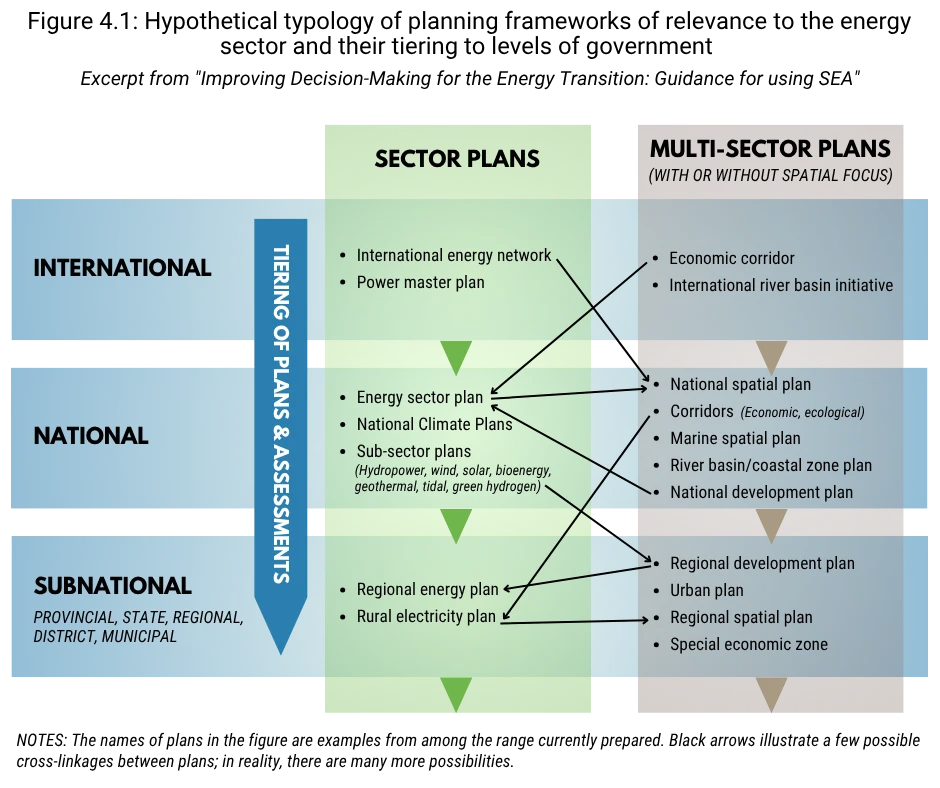
Countries face increasing pressure to develop renewable energy while maintaining energy security. The growing demand for land for energy infrastructure, such as solar and wind farms, highlights the need for spatial planning. Additionally, the reliance on a mix of fossil fuels and renewable energy will continue during the transition, which requires thoughtful integration of multiple energy sources.
Cross-sectoral integration in energy planning offers multiple benefits, including increased efficiency, economic savings and resilience. For example, using excess industrial heat for district heating or employing electric vehicles for energy storage can enhance overall system sustainability. SEAs play a critical role in aligning energy policies with broader environmental and social goals, ensuring that policies not only meet energy demand but also address issues like biodiversity loss, water use, and community impacts.
SEAs provide essential environmental and socio-economic data, facilitating better coordination between energy and other sectors such as agriculture, transportation, and land use. SEAs encourage public participation and stakeholder engagement, ensuring that energy policies and plans reflect the interests of affected communities. Moreover, they help identify the cumulative impacts of energy development on ecosystems and society, promoting more sustainable solutions.
The level of detail involved—for plans, SEAs, and project EIAs—increases through the hierarchical tiers of policy-making, planning, and projects, where information and issues are progressively transferred from one level to the next. See Figure 4.2 below.
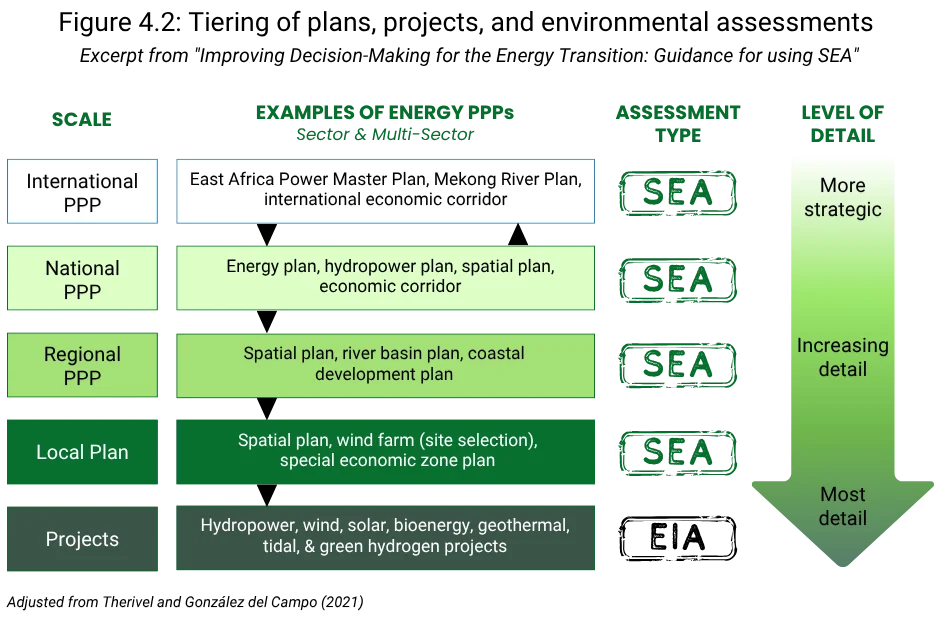
SEAs have been used worldwide to shape more sustainable energy decisions. The examples below illustrate how countries have applied SEA to national and sectoral energy plans—from Vietnam’s Power Development Plans to early policy SEAs in Central Europe and the UK’s Offshore Energy Program.
Vietnam’s Power Development Plans (PDPs) show how Strategic Environmental Assessment (SEA) can strengthen national energy planning. The first SEA, conducted for the Hydropower Master Plan under PDP VI, tested five scenarios comparing hydropower and thermal alternatives. This pilot revealed the need to better integrate environmental and social factors into power-sector planning.
Building on these lessons, the SEA for PDP VII (2011–2030) was prepared in parallel with the plan itself, analyzing electricity-demand scenarios and least-cost generation options. While full integration was still limited, the process raised awareness of environmental and efficiency concerns and informed a later revision of PDP VII.
The revised PDP VII (RPDP VII) became a model of good practice—embedding SEA throughout the planning cycle, improving alignment with national development policies, and elevating renewable-energy and greenhouse-gas-mitigation targets.
Source: ADB (2018)
See also Annex 28.
In the late 1990s, both the Czech and Slovak Republics applied Strategic Environmental Assessment (SEA) to guide major energy policy decisions.
In the Czech Republic, the 1997 Energy Policy SEA addressed the entire energy sector, including electricity, coal, gas, and the future role of nuclear power. It examined whether to complete a second nuclear plant and whether to extend open-cast coal mining that would destroy nearby villages. A national public hearing helped shape three modeled scenarios for alternative energy mixes, assessed against 16 environmental, social, and economic criteria.
In Slovakia, the updated Energy Policy SEA emphasized transparency and participation, incorporating expert reviews, public forums, and ministry statements. While the process improved public engagement, NGOs later criticized the policy for insufficient environmental and health assessment.
Together, these early SEAs demonstrated how participatory processes can strengthen—or expose gaps in—national energy planning.
Source: Dusik (2003ab)
Since 2001, the UK has completed a series of Offshore Energy SEAs (OSEAs) covering most of its continental shelf. These assessments have addressed oil and gas exploration, gas storage and offloading, carbon-dioxide transport and storage, and a range of renewable-energy technologies including wind, wave, tidal, and offshore hydrogen.
Each successive SEA expanded in scope and improved in methodology. The process now includes extensive consultation with the public, environmental authorities, industry, and neighboring states that might be affected. Oversight is provided by a multi-stakeholder Steering Group representing government departments, conservation agencies, NGOs, and independent experts.
The UK’s long-running OSEA program demonstrates how iterative SEAs can build institutional learning, strengthen transparency, and guide responsible offshore-energy development over time.
Source: Department for Energy Security and Net Zero (2013)
The energy transition is driving increased conversion of land for renewable energy projects, which can displace communities and disrupt ecosystems. SEAs help address these concerns by assessing potential impacts on biodiversity, water resources, communities, and cultural heritage. Energy policies must also prioritize reducing greenhouse gas emissions and promoting equitable access to energy, especially for marginalized populations.
As countries develop their energy PPPs, SEAs offer a valuable tool for ensuring that the energy transition is not only environmentally sustainable but also socially inclusive. By incorporating stakeholder input and addressing cross-sectoral impacts into energy plans, SEAs can help governments navigate the complexities of transitioning to renewable energy while balancing economic, environmental, and social priorities.